How Much Space Do You Need for a Dumpster?
A MAC Dumpsters container sits on a spot 12 to 14 feet long and 89 inches wide. To place it, our hook-lift truck typically needs about 50 feet of straight-line room to back in, 12 to 14 feet overhead and 10 to 12 feet of width. The 50 feet includes the street, so call if your spot is tight.
We're a roll-off dumpster company based in Middle River, placing containers on driveways, yards, lots and job sites across the Baltimore area. This guide covers each container's footprint, the room the truck works in, the surfaces we place on and when a street spot needs a permit.
- Owner-operated since 2023
- Our truck, our driver
- 5.0 on Google
- No delivery fee


Who backs the truck into your spot?
MAC Dumpsters does, with our own Ford F750 hook-lift truck and our own driver, never a subcontractor. Adam and Tara Graf have owned and run the company since 2023 from our yard at 1112 Middle River Rd. We place 10, 15 and 20 yard roll-offs across Baltimore City and Baltimore, Harford and Anne Arundel counties, and Google reviewers rate us 5.0.
What this placement and clearance guide covers
This page explains how much room a MAC Dumpsters roll-off and our delivery truck need. It covers the footprint of our 10, 15 and 20 yard containers, the straight-line, overhead and width clearance the truck typically works with, which surfaces we place on, and where street placement brings in a permit. It's written for driveways, yards and job sites around Baltimore, from rowhome blocks to rural lanes.
Where can a dumpster be placed?
A dumpster can go anywhere our truck can back up to in a straight line with room overhead: a driveway, yard, gravel pad, parking lot or job site. MAC Dumpsters places containers on any surface, paved or not. The exception is inside Bel Air town limits, where town code bars dumpsters from grass and other pervious surfaces.
Driveways
A driveway is where most home rentals go. The container needs its own length plus room for the truck to pull forward and clear it, and the approach can start from the street. Park cars elsewhere before we arrive.
Lawns, gravel and dirt
We place on grass, gravel and dirt as well as pavement. That matters on peninsula lots, rural lanes and older homes without a paved drive, where the only open spot is the side yard.
Parking lots and job sites
On a business lot or job site, pick a spot that stays out of traffic and deliveries for the whole rental. Tell us about gates, loading docks or crews working nearby when you book.
Loading height
Wherever the container sits, load it level with the top of the container. Anything above the rim has to come off before we can haul it, because loose debris can fall onto the road.
The street
A container on a public street or right-of-way usually needs a permit, and you're responsible for getting it. The rules depend on the county or town. Our dumpster permit guide shows which office covers your address.
Inside Bel Air town limits
Bel Air town code doesn't allow dumpsters on grass or other pervious surfaces, and limits a container on a residential property to 30 days without a Zoning Administrator extension. The rules apply inside town limits only. Bel Air North, Bel Air South and other addresses outside limits follow county placement. The dumpster permit guide above covers the towns that set their own rules.
How much room the truck typically needs
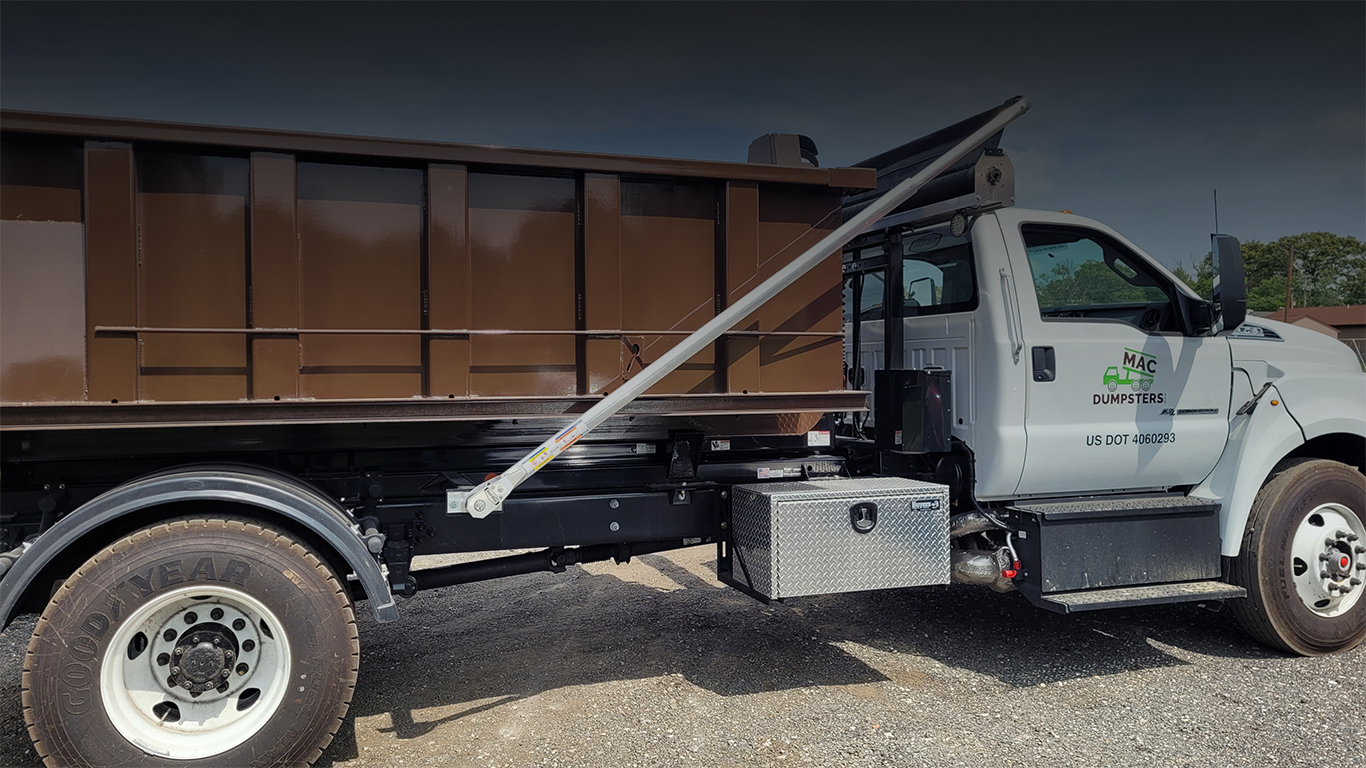
Our truck is a Ford F750 single-axle hook-lift. It backs up, tilts its arm and slides the container straight back onto the ground. These are the dimensions it typically works in. They're not hard minimums, so call if your spot is tight.
Straight-line room: about 50 feet
The truck typically needs about 50 feet in a straight line to back in, set the container down and pull forward clear of it. That's total working room, not driveway length, and the street counts toward it.
Overhead: 12 to 14 feet
As the container comes off, the hook arm rises. Keep 12 to 14 feet clear above the spot and along the approach, watching for power and cable lines, branches and roof eaves.
Width: 10 to 12 feet
The truck typically needs 10 to 12 feet of width along the path. Gateposts, fences, parked cars and narrow alley openings are what usually pinch it.
Hook-lift trucks work differently from other roll-off trucks. Types of dumpsters and trucks explains the difference.
How much driveway do you need for a dumpster?
For the container itself, you need a spot 12 feet long for a 10 yard or 14 feet long for a 15 or 20 yard, and 89 inches wide. The truck lines up from the street, so a short driveway often works. At MAC Dumpsters, the 10 yard is the easiest fit for tight driveways.
10 yard footprint: 12 feet by 89 inches
The 10 yard is 12 feet long, 89 inches wide and 38 inches tall. It's the shortest of our three sizes, and its low walls make it the easiest to load by hand.
15 yard footprint: 14 feet by 89 inches
The 15 yard is 14 feet long, 89 inches wide and 48 inches tall. It takes two more feet of length than the 10 yard for half again the room.
20 yard footprint: 14 feet by 89 inches
The 20 yard has the same 14 by 89 inch footprint as the 15, with 64-inch walls. If a 15 fits your spot, a 20 fits too. Only the height changes.
The walk-in door
Every size has one hinged walk-in door, so you can wheel or carry debris straight in. Leave a few feet clear at the door end so it can swing open.
How much overhead clearance does a dumpster need?
A dumpster itself stands 38 to 64 inches tall, but the truck that places it needs more. The hook arm on our truck rises as it sets the container down, so it typically needs 12 to 14 feet clear overhead. At MAC Dumpsters that applies to all three sizes, so call ahead if wires or branches hang low.

Getting your spot ready
A few minutes of prep on delivery day keeps the drop quick. How delivery and pickup work covers the timing.
- Move cars, trailers and trash cans off the spot and the approach
- Open gates and note anything low overhead
- Mark the exact spot if you want the container somewhere specific
- If the only spot is on the street, get the permit first
Placement and clearance questions
Can a dumpster go in a garage?
No. The hook arm on the MAC Dumpsters truck rises as it sets the container down, and it typically needs 12 to 14 feet clear overhead. That's far taller than a garage door opening, so the container goes on the driveway or pad in front of the garage instead.
Can a dumpster be placed right next to my house?
Usually, yes. The MAC Dumpsters truck needs to back in straight and typically needs 12 to 14 feet clear overhead, so eaves, gutters and wires along the wall decide how close the container can go. Call (410) 205-5330 before delivery if the spot is snug.
What if my driveway is too short for a dumpster?
It may not be. The MAC Dumpsters truck lines up from the street, so the driveway only has to hold the container: 12 feet for a 10 yard, 14 feet for a 15 or 20. If even that won't fit, the street is the fallback, and street placement usually needs a permit you get yourself.
How wide is a roll-off dumpster?
All three MAC Dumpsters sizes are 89 inches wide, just under 7½ feet. The 10 yard is 12 feet long and 38 inches tall, the 15 yard is 14 feet long and 48 inches tall, and the 20 yard is 14 feet long and 64 inches tall.
Where should a dumpster go for a roof job?
As close to the roofline you're tearing off as the truck can reach. The MAC Dumpsters truck typically needs 12 to 14 feet clear overhead, so keep the spot away from low eaves and wires. Shorter carries from the ladder save the crew time, and shingles are heavy to haul across a yard.

Tell us about your spot
Tell us where you want the container when you book, and flag anything low, narrow or soft. Book online, or call (410) 205-5330 if your spot is tight and we'll talk it through.
